

Ultrahigh-resolution 3D monitoring reveals sediment-derived plumes as algal bloom precursors
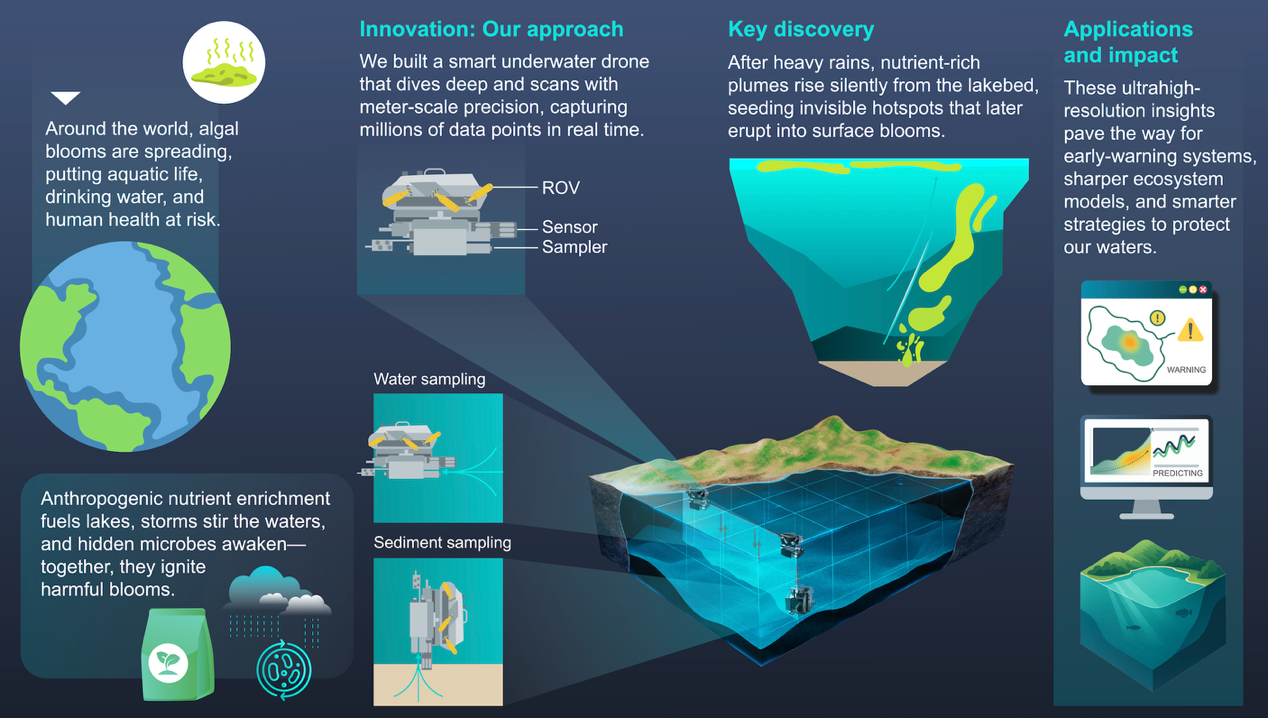
GA, UNITED STATES, January 7, 2026 /EINPresswire.com/ -- For years, harmful algal blooms appeared to strike without warning, turning pristine lakes into thick, green sludge overnight. Now, researchers using autonomous "lake-scanners" have discovered that these disasters are not sudden events but the climax of a stealthy, multi-day journey beginning at the dark bottom of the lake.
The Invisible Ascent
Globally, toxic algal blooms are becoming more frequent and severe, fueled by a warming climate and nutrient runoff. While satellites can easily spot the green carpets once they reach the surface, the "prequels" to these outbreaks remain hidden in the deep.
Researchers from Harbin Institute of Technology and collaborating institutions reported their findings on December 25, 2025, in Environmental Science and Ecotechnology. "This study fundamentally changes how we understand algal bloom initiation," says Dr. Troy Yu Tao, Associate Professor at Harbin Institute of Technology. Instead of a sudden explosion at the surface, the team found that blooms follow a "bottom-up" process triggered by a previously invisible phenomenon: sediment-derived plumes.
A "3D CT Scan" for Lakes
To see through the murky depths, a team from the Harbin Institute of Technology and collaborating institutions deployed an autonomous underwater drone equipped with high-precision sensors. Over four months, this "underwater scout" collected more than 2.8 million data points, creating a high-resolution 3D map of the water column—effectively a medical-grade scan for the lake.
By monitoring at a resolution of just one vertical meter, the researchers captured the life cycle of a bloom in three dramatic acts:
1.The Awakening: Heavy rainfall triggers turbulence that stirs the lakebed, resuspending dormant algal cells and nutrients.
2.The Stealthy Ascent: Rather than drifting aimlessly, these cells form "coherent plumes"—concentrated columns of biomass that begin to climb toward the light.
3.The Outbreak: After a delay of one to two days, these plumes hit the surface and expand horizontally, finally becoming visible to the naked eye.
From "Firefighting" to Early Warning
The discovery of this 48-hour delay is a game-changer for water management. Conventional monitoring often identifies blooms only after they have already peaked, leaving authorities in a "reactive" mode.
By detecting these "ghost plumes" as they leave the sediment, water managers can shift to proactive prevention. Targeted interventions, such as localized sediment management in high-risk "hotspots," could stop a bloom before it ever reaches the surface. As extreme rainfall events become more common, this ability to "see" the invisible will be vital for safeguarding drinking water and aquatic life worldwide.
###
References
DOI
https://doi.org/10.1016/j.ese.2025.100652
Original Source URL
https://doi.org/10.1016/j.ese.2025.100652
Funding information
This work was supported by the National Natural Science Foundation of China (No. 52321005, No. 52293443, and No. 52230004), Shenzhen Science and Technology Program (No. KQTD20190929172630447), Shenzhen Key Research Project (No. GXWD20220817145054002), Shenzhen Natural Science Foundation (No. JCYJ20240813104812017), and Talent Recruitment Project of Guangdong (No. 2021QN020106).
About Environmental Science and Ecotechnology
Environmental Science and Ecotechnology (ISSN 2666-4984) is an international, peer-reviewed, and open-access journal published by Elsevier. The journal publishes significant views and research across the full spectrum of ecology and environmental sciences, such as climate change, sustainability, biodiversity conservation, environment & health, green catalysis/processing for pollution control, and AI-driven environmental engineering. The latest impact factor of ESE is 14.3, according to the Journal Citation ReportsTM 2024.
Lucy Wang
BioDesign Research
email us here
Legal Disclaimer:
EIN Presswire provides this news content "as is" without warranty of any kind. We do not accept any responsibility or liability for the accuracy, content, images, videos, licenses, completeness, legality, or reliability of the information contained in this article. If you have any complaints or copyright issues related to this article, kindly contact the author above.
